

Every January, the marketing world performs the same ritual.
It's trend and prediction season.
Whether it's on LinkedIn, media publications, or your preferred podcast, they are everywhere and we often end up with a long list of buzzwords:
AI-first strategies, authenticity-driven communication, hyper-personalisation, short-form vertical video, and privacy-first data collection…
and a dozen others that all sound vaguely correct, but rarely translate into actionable insights.
The problem is that they are too broad, too generic. There is a difference between identifying a trend and understanding how to act on it.
So instead of adding to the noise, I'm sharing three specific developments that offer measurable ROI for small and medium businesses right now, not in some hypothetical future.
These aren't predictions. They're practical areas where you can make real progress this year.
1) Small Language Models are a real alternative
An SLM is a language model built on the same transformer architecture as the large ones (ChatGPT, Claude, Gemini), but with far fewer parameters (1 to 10 billion compared to 175 billion parameters).
That reduction in size changes the economics of AI fundamentally.
- Lower computational costs: SLMs require significantly less processing power and can run on standard servers or CPUs rather than requiring expensive, specialised hardware.
- Faster inference with better security: Smaller models process requests more quickly, reducing latency and improving user experience. Since they can run on standard servers, they can be deployed in private, on-premises environments, giving you complete control over sensitive data.
Instead of paying for general-purpose AI capability you may not fully utilise, you can deploy right-sized models for specific marketing workflows at a fraction of the cost in controlled environments.
You Are Finally Getting AI ROI in 2026
Researchers at Wharton tracked enterprise AI adoption from 2023 through 2025, revealing a clear progression: from exploration to experimentation to what they now call "accountable acceleration."
The question for 2026 has shifted from "can AI work?" to "what is the measurable ROI of AI in real operations?"
For small and medium businesses, generating measurable outcomes is particularly important.
And SLMs might well be the solution for many smaller businesses. Beyond the improved economics, the ability to deploy SLMs on private servers running with standard CPUs opens the door for companies to train models on their own proprietary, domain-specific data without the fear of leaking sensitive information.
Imagine an AI trained to understand your specific business context, terminology, customer patterns, and brand identity to perform specific marketing tasks like:
- summarising customer feedback
- drafting variations of product copy
- extracting key points from sales calls
- classifying leads
- generating localised content
- turning internal knowledge into usable snippets for teams
We are not talking generic ChatGPT answers, but highly relevant solutions for your specific situation. This represents a genuinely useful AI application for business operations.
Irugalbandara and colleagues analyzed the cost-benefit trade-off of replacing proprietary LLMs with smaller open alternatives in their 2024 research. Their findings suggest that meaningful cost reductions are possible while maintaining competitive performance in many production tasks.
How Do You Start?
Your goal is not to "build a full stack AI capability."
Aim to reduce friction in the workflows that already exist. Pick one specific marketing process and build a small, private AI assistant around it. For example:
- A Review Summariser that classifies customer reviews into themes and creates a weekly insight memo
- A Product Copy Assistant tuned on your best-performing copy and brand voice
- A Sales Argument Writer that turns common objections into short rebuttal scripts
If you still feel stuck, check out this short and helpful free guide from our friends at Gopf on how to implement an AI solution without losing your mind: The AI Laboratory: Small Bets, Big Impact
2) The Shift from Ranking to Being Cited
The second topic I want to emphasise is Generative Engine Optimisation (GEO).
I have touched on this shift in my article about AI chat monetisation, but I believe it's an important one worth revisiting.
GEO is the practice of optimising content so that it is cited, recalled, and trusted by AI-driven platforms such as ChatGPT, Perplexity, and Google's AI Overviews.
Traditional SEO tries to win your content the best position in search results, whereas GEO tries to win a place in a conversational AI answer.
The risk of losing website traffic to conversational AI platforms is real and has already been highlighted by researchers (Padilla et al., 2025).
Why This Matters in 2026
According to Kantar's 2025 report on AI consumer behavior, 24% of AI users already rely on AI shopping assistants to delegate part of the buying process like comparing products and creating product shortlists.
MMR even suggests that full agentic commerce, where AI makes the purchase for you, will happen in 2026.
I'm not convinced we will see a lot of it this year. Customer behaviour (and trust) tends to evolve slowly and the infrastructure is not ready yet for large scale automated and AI-driven commerce.
Nevertheless, whether we like it or not, people are increasingly using conversational AI chats to research, compare, and soon buy products. This poses a risk for brands that are not mentioned by AI.
With an increasing number of users turning to AI chats not only for answers to their questions, but for part of their customer journey (check out my article on AI monetisation for a more detailed look at how AI chats influence the customer journey), if your brand and products are not cited by conversational AI chats, your brand will no longer be considered by the customer.
If you don't want to be left behind, start thinking in terms of GEO by making your content more machine-readable to increase your chances of being cited by ChatGPT and similar platforms.
You are not only marketing to humans. You are increasingly marketing to systems that filter the human's options.
SMBs Have an Unexpected Advantage
SMBs are usually closer to the market and their customer problems. This allows them to create more specific, experience-based content that AI systems are more likely to cite and trust.
According to NP Digital's 2026 trends analysis, search engines and AI platforms now prioritise mentions and references over traditional link equity. Brand citations are replacing backlinks as a ranking signal.
When your brand is cited in context, especially with specific use cases, comparisons, or expert commentaries, you gain visibility in AI-generated answers.
You can document specific outcomes and publish nuanced, useful content faster than larger competitors tangled in approval chains.
A Few Practical GEO Moves from NP Digital:
- Eliminate marketing fluff, add quantifiable information. AI systems prefer specific, actionable details over vague emotional language. Instead of "industry-leading solutions," write "reduces processing time by 40%." Quantify what your products actually do.
- Build brand citations across the web. Brand citations have replaced backlinks as the primary ranking signal. Focus on getting your brand mentioned positively across platforms (partners, niche media, community posts, reviews). The link itself matters less than whether your brand is being cited with positive sentiment.
- Turn key pages into decision assets. Add a "How to choose" section to important pages: who you are best for, who you are not for, and 3–5 criteria to compare options. Make it easy for AI to position you in context.
- Make your site technically crawlable and data-rich. Use schema markup and structured data on key pages. If your site is hard to crawl (especially JavaScript-heavy sites), AI crawlers will skip you and pull information from competitors instead.
- Build topical authority through valuable content. Even when your content isn't directly quoted, it's being used for AI training data. Creating valuable, specific content that AI systems leverage builds trust and authority, leading to better recommendations over time.
If you want to better understand how the customer journey is impacted by conversational AI and prepare your brand for AI chat ads, check out the 3C framework I this article.
3) Relevance Beats Production with Fastvertising
In a recent Harvard Business Review article, researchers explore how advertising must evolve in today's social media-driven environment.
They make the case for what they call "fastvertising", a strategy where brands capitalise on real-time cultural moments to earn disproportionate media attention with low-production-cost content.
The concept isn't new. Newsjacking, or realtime marketing, has been around since the start of the social media era. I still discuss Oreo's famous Super Bowl blackout tweet from 2013 with my marketing students as a textbook example.
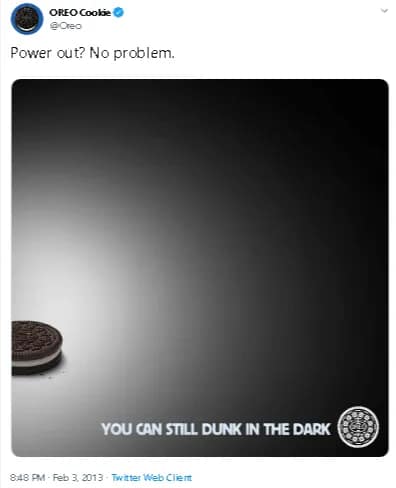
Since then, brands have attempted to capitalise on shared experiences in near real-time, to break through the noise and earn media exposure.
The Oreo "dunk in the dark" tweet worked not because it was polished, but because it was perfectly timed and culturally synchronised.
So why is this more relevant in 2026?
The Interest Graph Has Changed How We Consume Content
In my view, the rise of interest-graph algorithms has fundamentally changed what audiences accept and reward.
TikTok pioneered this shift, Instagram Reels followed. These platforms don't prioritise content from accounts you follow (the social graph). Instead, they surface content based on what you're interested in, regardless of production quality.
The result? Relevant low-cost, smartphone-shot content now performs as well as, and often better than, polished studio productions. Audiences reward relevance and timing over production values.
This shift democratises fastvertising. You no longer need creative agencies and production budgets to participate in real-time moments. You need speed, cultural awareness, and the confidence to publish quickly.
It's Not Only for Big Name Brands
SMBs often assume fastvertising is a "big brand game" reserved for companies with big budgets, creative agencies, and dedicated social media war rooms.
In reality, SMBs have strengths that make them better suited to fastvertising than many large brands:
- Fewer approval layers: You can decide and publish in minutes, not days.
- Closer proximity to customers and culture: You feel shifts in tone, context, and customer sentiment faster because you're in direct contact with your market.
And with generative AI, it's now possible to create multiple variations of a response in seconds and iterate quickly.
But before you get started, as the HBR researchers note, AI can't determine tone, timing, or emotional subtext. That still requires human judgment.
For all these reasons you should try fastvertising in 2026.
The Five Pillars of Fastvertising Success
According to the Harvard Business Review article, successful fastvertising requires five core elements:
- Speed is crucial: Cultural moments pass quickly; you need to respond while they're happening.
- Relevance beats production values: Cultural proximity matters more than polish (examples: IKEA's Game of Thrones rug guide, Aviation Gin's Peloton response).
- Trust and organisational fluidity enable agility: Requires empowered, cross-functional teams that can act without layers of bureaucracy.
- Humour, humility, and humanity fuel connection: Getting the emotional tone right is critical (KFC's "FCK" apology vs. Kenneth Cole's Arab Spring misstep).
- Failure is cheap and necessary: Low production costs mean you can experiment and occasionally miss without major consequences.
You don't need to shift to a fastvertising-only strategy in 2026, but try it out when you feel the moment is right. You know your customer, you know your industry, use it to your advantage.
So What Is 2026 Going to Look Like for You?
If you're on social media you are probably inundated with posts telling you the end of whatever you are doing.
But this is mostly just noise.
Mark Ritson has written a great article on another noisy topic in marketing - the death of everything, if you are interested).
The same goes for all the 2026 trends. Mostly noise.
Here's what I recommend instead: ignore the comprehensive 2026 prediction lists. Pick one area where you can make measurable progress based on your actual resources.
As a consultant, what I recommend is that you focus on improving one aspect of your marketing based on your available ressources. Whether it's a task, a workflow, a campaign, or a new technology.
This could be:
- Training an SLM on your proprietary data and having an actually useful chatbot on your website
- Starting to review your most important content and defining new guidelines in line with GEO
- Setting up a small "SWAT Team" that is ready to capitalise on the next cultural moment in your industry
Pick the one that resonates with you and focus on that.
And I'm curious: which of these three topics will matter most in your industry in 2026?
Let me know in the comments.
If you want more research-backed, practical marketing insights, you can subscribe to my newsletter. That's where I break down academic research, relevant reports, and emerging shifts, then translate them into insights you can actually use.
