

There is this smaller social network that has fewer users, but the right ones.
You have probably heard this or something similar from your agency.
Their argument is that the users on those platforms are more engaged, more loyal, and more receptive and your brand would not be competing for attention against everyone else.
The pitch seems appealing because it flatters two things at once: a budget that cannot compete on the dominant players, and the sense that your customers are distinctive.
However, new research, currently in press, suggests that this promise does not hold.
Klepek, Cui, Cui and Thulaseedharan Mallika, publishing in the Review of Marketing Science, tested whether two of the oldest empirical regularities in marketing (the double jeopardy and duplication of purchase laws) hold when describing how people behave on social media.
This study caught my attention not only because I teach these laws as part of my marketing course, but also because for years I have been telling clients that smaller organisations can benefit when they concentrate their limited resources on bigger platforms. This study adds evidence to this claim by using robust methodology.
How the study was built: four datasets, two countries, nine years
Klepek and colleagues did not build their case on a single set of data. They analysed four datasets covering more than 4,200 people in China and the Czech Republic, collected between 2016 and 2025. Three of the four data sets were gathered for entirely different research purposes and re-examined afterwards, which makes it unlikely that the data were shaped to fit the hypothesis.
This methodology follows the many sets of data approach set out by Andrew Ehrenberg (1990), the tradition behind the Ehrenberg-Bass Institute and Byron Sharp's How Brands Grow, which trusts a pattern repeating across different populations more than a single well-designed study.
Social media was chosen deliberately as a hard test. Network effects, algorithmic personalisation and near-zero switching costs are precisely the conditions under which these old regularities should break down, if they were going to break down anywhere.
Interestingly, they did not break down. On the contrary, they intensified. But before we look at the implication of the study for your social-media strategy, let us look at the two laws in more detail.
The double jeopardy law: why smaller platforms are penalised twice
The double jeopardy law was first described by William McPhee (1963) and later extended to brand purchasing by Andrew Ehrenberg (1972). The law states that smaller brands are penalised twice: they have fewer customers, and those customers are also less loyal.
Most marketing practitioners expect a trade-off here. Since a small brand loses on size, it must win on loyalty. Double jeopardy suggests that the compensation never happens (Ehrenberg and Goodhardt, 2002).
Applied to social media, the study finds that platforms with larger user bases have both more users and proportionally higher usage frequency and that smaller platforms do not host a more committed audience. In fact, they have fewer people who visit less often (Klepek et al., in press).
This finding matters for how you assess a platform’s potential. When a platform presents you its engagement figures, it is presenting a consequence of its size as though it were a property of its community. In other words, engagement follows scale, and a smaller platform claiming a more loyal audience is claiming something the data does not show.
The duplication of purchase law: why platform audiences overlap
The duplication of purchase law holds that brands share customers in proportion to their size (Ehrenberg, 1988). If you buy a small brand, you very probably also buy the large one, and the amount of overlap is predictable from market penetration alone.
Klepek and colleagues adapted this behavioural pattern to social network usage, instead of purchase, and adopted the term duplication of usage, since nobody purchases access to a social network.
Across all four datasets, the overlap between platforms tracked relative penetration almost mechanically, with correlations above 0.99. Every platform shared most of its users with the largest one (Klepek et al., in press).
An important detail is that this overlap runs in one direction only. For example, in the study of Chinese cooking content, 82% of users of the small app DouGuo also used TikTok, while the reverse figure was far lower.
In other words, this means that small platform audiences are not separate segments. They are near-identical subsets of the large platforms’ audiences.
Translated to media planning, the consequence is direct. Adding DouGuo to a campaign already running on TikTok delivered an incremental reach of roughly 0.5%.
This shows that by adding a smaller platform to your media plan you are not fishing in a different pond (increasing the audience), but merely fishing in a corner of the same one (same audience).
What the study cannot tell you
Although these findings are revealing, each of the four datasets, taken on its own, has clear limitations.
None of the four samples is nationally representative, three of the four rely on self-reported behaviour, and measuring loyalty as usage frequency cannot distinguish genuine attachment from habit. The authors state all of this themselves.
However, the obvious objection from marketing professionals might come from the geographic coverage of the study. The data sources are Chinese and Czech, so why should it describe Germany, the UK or Switzerland?
This is where it gets interesting and where the design of the study helps us invert that objection. The weakness of any single sample is answered by the consistency across them: the study covers two digital ecosystems with almost no platform overlap between them, studied nine years apart, yet producing near-identical patterns. A pattern that repeats across such different conditions is stronger evidence of a structural regularity than one representative national sample would be. That is the entire point of the many-sets-of-data design mentioned earlier.
Furthermore, these findings do not stand alone. Harsh Taneja found comparable double jeopardy effects across the 2,000 most popular websites in the United States, concluding that popularity predicts usage and that audience niches are less common than assumed (Taneja, 2020). These effects were moderate rather than overwhelming, and stronger at the top of the distribution than in the tail, which is worth knowing before anyone overstates the case.
However, the pattern also reaches beyond platforms. Anesbury and colleagues examined 84 million music listening observations and found duplication holding across genres, artists, albums and songs, with no evidence of partitioned listening. Their conclusion is a direct challenge to Kevin Kelly's popular 1000 True Fans: musicians should try to reach all potential listeners, not only the ones who already resemble their existing audience.
None of this makes the question settled. The authors themselves invite replications in other content domains, such as fitness, travel or fashion, and every new context is another opportunity for the pattern to fail. Until it does, the safer planning assumption is that it holds.
But why does this matter for small organisations?
Why niche platforms attract the wrong audience
There is one detail in the study that deserves more attention than the authors gave it, in my opinion.
The cooking study only surveyed people who cooked at least three times a week. That is a screened population of more committed enthusiasts, exactly the audience a niche platform pitch is built around. However, even within that group, the specialist cooking apps still had fewer users and lower usage frequency than the general platforms. The authors note that the gap would widen in an unscreened sample (Klepek et al., in press).
This is worth sitting with. What it means is that niche platforms over-index on the most committed users of a category, who are already served and usually the hardest to move. On the other hand, broad platforms reach the light and occasional users, and Byron Sharp's work suggests it is the light buyer who switches most readily.
So the niche platform does not just give you fewer people. It tends to give you the wrong ones.
How to choose social media platforms: Rank, Concentrate, Justify
One reason many marketers do not apply evidence-based findings is the lack of practical tool sets available for day-to-day decision making.
The following is an organising principle rather than a full methodology, but it keeps the decision honest and it gives you a tool to make better decisions.
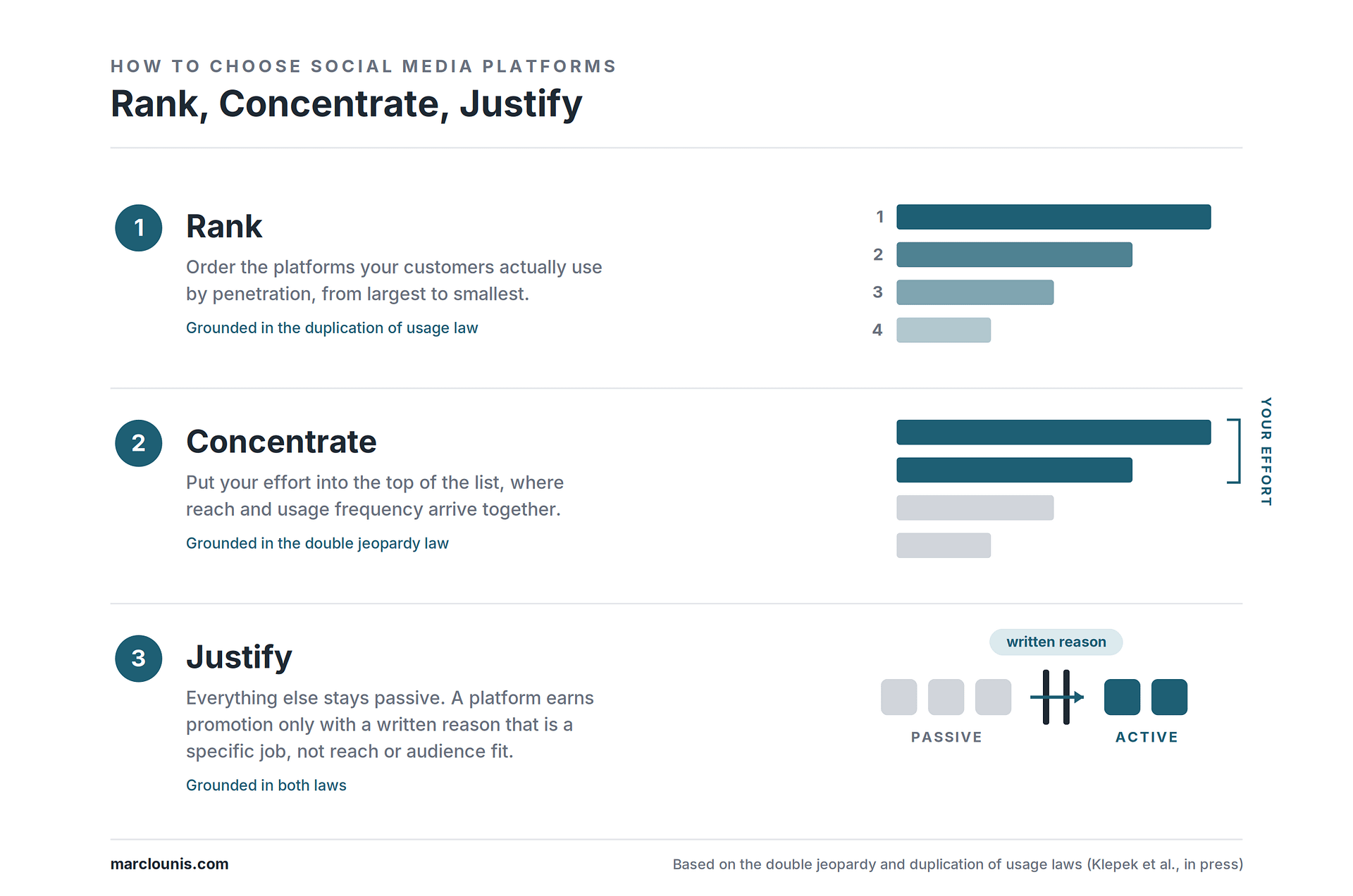
- Rank. Start by identifying which platforms your customers actually use, ordered by penetration. Not by where you feel comfortable, not by where your competitors are. In most Western markets you will find Meta properties near the top, but the ranking is yours to establish rather than mine to assert. Duplication of usage is what justifies ranking by penetration: because audience overlap follows platform size, a penetration-ordered list is the only one that lets you predict how much genuinely new audience each additional platform would add.
- Concentrate. Then put your effort into the top of that list. Double jeopardy is what makes this efficient. The platforms with the most users are also the ones people use most often, so reach and frequency arrive together instead of trading against each other.
- Justify. Everything below the top of your list defaults to what I call a passive network: you keep the profile alive, point visitors towards your active channels, and review it perhaps twice a year. A platform earns promotion to active only with a written reason that is neither reach nor audience fit, because both of those arguments have now been answered. What survives as a legitimate reason is a specific job: a defined professional audience, a format worth testing, or a channel your customers use for service.
One caution. Size does not rescue a genuine audience mismatch. In the cooking data of the study, Bilibili underperformed its size because its users skew young and cook less. It is therefore important to pick the largest platform whose audience plausibly contains your buyers, which for most organisations is the same platform, but not always.
Three steps to apply this framework this week
Here are three concrete things you can act on this week based on the Rank, Concentrate and Justify framework.
- Run the duplication survey on your own customers. The most recent study in this paper was three questions sent to 854 people. Use the same approach and send out a short survey asking your customers to tick every platform they use. Then create a duplication of usage table by calculating, for each platform, what share of its users also use your main channel. In the research, such a table is a full matrix showing the overlap between every pair of platforms; for your purposes, one column is enough, each platform measured against your main channel. Where that share is low, you have found genuine incremental reach. Everywhere else, you are paying twice to talk to the same people. The authors do not suggest this, but their method makes it straightforward.
- Audit before you add. For every channel you currently maintain, assess whether it delivers reach or completes a specific job that is not reach. If the answer is neither, put it on hold in the passive category, or close it. For most smaller organisations the binding constraint is not only media budget but also the capacity to produce good content, and two channels done properly will beat five done badly.
- You now have empirically grounded arguments. When someone proposes a new platform, the pitch almost always rests on a more engaged audience or on people you cannot reach elsewhere. Double jeopardy answers the first. Duplication of usage answers the second. Both are now empirical justifications rather than matters of opinion, so ask for evidence to the contrary.
I can apply this to myself. Although LinkedIn is far from the platform with the largest audience, it is still where I publish. Not because the audience is more engaged, but because the job I need that channel to do is not reach at all. That is the exception clause working as intended, and it is the only kind of justification that should survive.
One last thing: reach is not attention
It is important to highlight that this study tells you where audiences are. However, it does not tell you what captures those audiences’ attention, what that attention costs, or how it converts.
Attention researcher Karen Nelson-Field argues that paid-for reach and delivered attention diverge sharply on scrollable media, which means equivalent impressions on different platforms do not carry equivalent value. Her company sells attention measurement, so read the finding with that interest in mind, but the underlying point stands.
Concentration tells you where to look first. It does not tell you what you will find when you get there.
In the end, you do not need a bigger budget to make better platform decisions. You need to stop paying for audiences you already have.
The research suggests that most of the platforms competing for your attention are offering you a subset of the people you can already reach, described in language designed to sound like a segment. Ranking honestly, concentrating deliberately, and demanding justification for anything else is not a sophisticated strategy. It is simply the one the evidence supports.
If you find this kind of evidence-based content useful, subscribe to my newsletter, where I break down recent marketing research and translate it into frameworks you can actually use.
I am curious how this lands in your market:
- Which platform have you kept out of habit rather than evidence?
- Has a smaller platform ever delivered reach you genuinely could not get elsewhere?
- If you ran the duplication test on your own customers, what do you think you would find?

Marc Lounis
Sources
Anesbury, Z.W., Davies, C., Driesener, C., Page, B., Greenacre, L., Yang, S. and Bruwer, J. (2023) ‘Death by 1000 “true fans”: do marketing laws apply to music listening?’, Journal of Consumer Behaviour, 22(1), pp. 82–97. Available at: https://doi.org/10.1002/cb.2114
Ehrenberg, A.S.C. (1972) Repeat Buying: Theory and Applications. Amsterdam: North-Holland.
Ehrenberg, A.S.C. (1988) Repeat-Buying: Facts, Theory, and Applications. New edn. London: Griffin and New York: Oxford University Press.
Ehrenberg, A.S.C. (1990) ‘A hope for the future of statistics: MSoD’, The American Statistician, 44(3), pp. 195–196.
Ehrenberg, A. and Goodhardt, G. (2002) ‘Double jeopardy revisited, again’, Marketing Research, 14(1).
Kelly, K. (2008) ‘1,000 True Fans’, The Technium. Available at: https://kk.org/thetechnium/1000-true-fans/ (Accessed: 9 August 2026).
Klepek, M., Cui, D., Cui, M. and Thulaseedharan Mallika, S. (in press) ‘Applying marketing laws to social media: cross-cultural evidence for duplication of purchase and double jeopardy’, Review of Marketing Science. Available at: https://doi.org/10.1515/roms-2025-0080
McPhee, W.N. (1963) Formal Theories of Mass Behavior. New York: Free Press.
Nelson-Field, K. (2023) interviewed in ‘Reach curves have gone rogue’, Mi3, 5 April. Available at: https://www.mi-3.com.au/05-04-2023/reach-curves-have-gone-rogue-karen-nelson-field-warns-scrollable-media-attention-decay (Accessed: 9 August 2026).
Sharp, B. (2010) How Brands Grow: What Marketers Don’t Know. Oxford: Oxford University Press.
Taneja, H. (2020) ‘The myth of targeting small, but loyal niche audiences: double-jeopardy effects in digital-media consumption’, Journal of Advertising Research, 60(3), pp. 239–250. Available at: https://doi.org/10.2501/JAR-2019-037